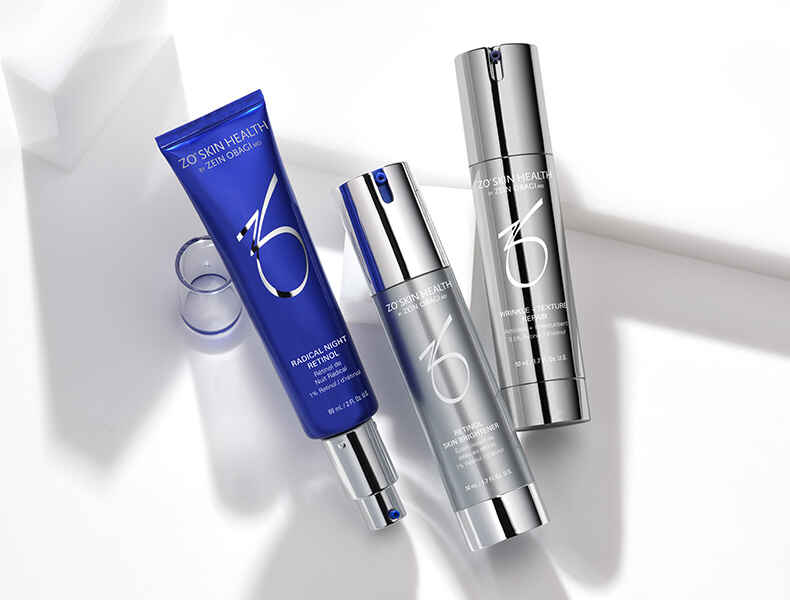
Retinol and Sensitive Skin
Lots of people think that sensitive skin means that they have delicate or fine skin. NOT! Sensitive skin is weak skin!
No one is born with sensitive skin. And it’s usually just women who complain of sensitive skin–not men or children. Why? It’s because the skin becomes lazy from the use of too much moisturizer, and intolerant from the use of products with perfumes, dyes and additives.
So once people think that they have sensitive skin, they start using products that are weak–which only further weakens their skin! So the problem continues, or gets worse.
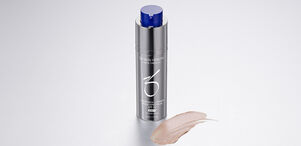
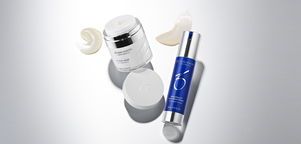
In order to successfully treat symptoms—redness, itching, and bumps—we have to improve overall skin quality and reduce the reactive nature of sensitive skin. The best treatment for sensitive skin is a program of skincare products with retinol, because that strengthens skin, and enables skin to renew itself. A skin-strengthening product such as ZO Skin Health’s Radical Night Repair is an important step toward resolving sensitive skin issues. Retinol increases cell turnover which forces the damaged surface cells to slough off, allowing the new healthy cells to emerge. Because Radical Night Repair contains 1% retinol, a natural form of Vitamin A, it replaces what the skin has lost over time, (the ability to stimulate the retinoid-receptor found on every cell) and takes the skin to a new healthier state–and that is important in the treatment of sensitive skin.
The use of retinol, in some cases, can increase skin redness. Although it sounds counter-intuitive, that is why Radical Night Repair is especially great for sensitive skin. ZO Skin Health’s Radical Night Repair uses an encapsulated, time released delivery system that gently delivers the retinol load over a 6 – 8 hour period, while you sleep. We recommend using Radical Night Repair only one night a week, to start. This will gradually increase skin tolerance, and will prepare the skin, so that the treatment can be used more often. Long term regular use of retinol will provide the skin with the vital nutrient, (vitamin A) it needs to be healthier and less reactive to the environment.
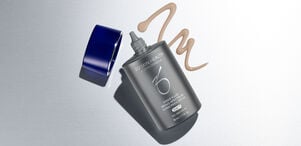
Products with high concentrations of retinol will cause peeling, and make your skin more vulnerable to UV rays. So be sure to wear a full spectrum sun protection!
What’s Your Skin Age?
We all know how old we feel (and some days we feel younger than others!), but how old do we look? It’s harder to be objective about that.
That’s why Dr. Obagi developed the Skin Age test, a 5-minute questionnaire that enables you to assess your skin type, concerns, lifestyle, genetics, etc., and make an accurate projection of whether your skin makes you look older–or younger–than you really are. Immediately you’ll get an assessment of the factors that influenced your score, as well as some recommendations. There are some things that may surprise you–like the role of ethnicity, HRT, anti-depressants, diet, etc. Based on your input, there is also a proposed regimen–what you need to do to correct or maintain your skin. If you wish, you can print a copy of the regimen for your records. And if it looks really, really good, you can show it to your friends!!
The test is free, and so is the evaluation. Check it out at: http://www.zoskinhealth.com/skin-age-test.html
Have fun! And tell us what you think!