ZO Skin Health

So you don’t need sunscreen on a cloudy day, huh?

THIS IS ABSOLUTELY WRONG! When your mother told you that you need to wear sunscreen every day, she was right!

UV radiation from the sun comes right through the clouds, not to mention directly through an office or car window…. The odds of getting a sunburn are slight, as the UVB rays are short and will not have a direct affect on the skin. However, the UVA rays are very long and penetrate deep into the lower layers of the skin, where new skin cells, collagen and elastin are formed.

Here’s an easy way to remember the difference.  With UVB rays (the B “stands” for Burning)– will burn or tan your skin.  With UVA (the A “stands” for Aging)– skin color won’t change, but the rays will cause premature aging. And that’s not all.

When the DNA in the skin cell is damaged by UVA radiation, you have the potential for many types of skin cancer and advanced photo-aging. Within each skin cell, on the DNA helix, there is a “damage receptor”. When the cell is struck by UVA radiation from the sun, the receptor tells the cell it is damaged, and the cell self-destructs and goes away. When the receptor itself is struck, there is no message back to the cell that something is wrong. The damaged cell now duplicates itself, and starts a chain reaction, producing many more damaged cells. This is when the signs of skin aging begin.

70% of all UV damage is from casual exposure, getting unintended sun on your skin.

UVA radiation can penetrate directly through the clouds, and a window, so if you have the “primo office” with a view, (depending on which direction it faces), you can catch the morning UVA rays or the late day UVA rays, right at your desk. The same goes for your trip to and from the office, in the morning the sun will get you from the easterly direction on your way into work, and the westerly direction as you head home. This is why wearing a sunscreen daily, even on a cloudy day, or if you plan on being indoors all day, is so important.

Be sure to use an SPF 30, which is considered maximum protection. Choosing a sunscreen that uses physical blocks (like zinc oxide and titanium dioxide) are excellent ways to protect your skin from UV damage. ZO Skin Health by Zein Obagi, M.D. uses not only zinc and titanium, but also adds melanin, a natural, photo-protective agent with antioxidant properties.

ZO Skin Health

You Can’t Make Long-Term, Sustainable Changes to Your Skin… Really?


Yes, you can! By removing the top layers of dead skin cells and activating the lower dermis, (where all the action is) the texture, tone and firmness of your skin can change. If your products and treatments only work on the surface, all you are going to get is a temporary cosmetic effect and no real change. Think of the top layers of your skin as a dried sponge. If you get it wet, it will soften and plump, if you leave the sponge out on the counter, it will just dry up again. Consequently, you will have a temporary change, but inevitably, the sponge will go back to its original dry state. If you can get past the top layers and slough them off, you can open up pathways to deliver nutrients, antioxidants, hydration, and the essential building blocks to build support structures as in collagen, elastin, hyaluronic acid and healthy new skin cells. The result will be skin that appears smooth, soft, firm, radiant, AND the look won’t wash off.

Here is Dr. Obagi’s recommended approach to producing lasting changes and not just a temporary cosmetic cover-up:

  1. Seek the guidance of a licensed skin care professional.
  2. Start on a regular program of daily cell renewal, using a high concentration of retinol (NATURAL Vitamin A)
  3. Accelerate resurfacing with more aggressive professional resurfacing treatments (microdermabrasion and laser).
  4. Supplement your daily resurfacing regimen, with application of nutrient rich antioxidants and growth factors.
  5. Use targeted products to treat specific conditions: acne, hyperpigmentation, rosacea, tired eyes, etc.
  6. Use injectables such as Botox® to smooth the frown and Juvederm® to fill in the deeper wrinkles.  Be sure to ask your doctor for his/her brand recommendations, though, as not all fillers are the same.
  7. Apply sun protection every day.
  8. Stay on track with proper coaching and support from your skincare specialist.

ZO Skin Health

Get Your Skin Ready for Fall

Everyone loves summer, right?  Your skin doesn’t.  It suffers from the heat and intense UV rays.  The result:  dull, dry damaged skin.

It’s autumn, and for your skin, that’s very good news.  Just as we all look forward to relief from the heat and intense UV rays, so too your skin benefits from the cooler temperatures and less intense light.

And your skin is more than ready for change.  Because after several months of summer, your skin has accumulated a lot of dull, dry and damaged skin cells.  It’s ready for new skin cells to emerge and brighten your complexion.

Here are 6 easy (and one that is not-so-easy) ways on how to re-energize your skin:

  1. First, undo the summer damage, and exfoliate—from head to toe.  My favorite, for your face, is ZO Skin Health’s Exfoliating Polish.  It does a great job of scrubbing away the dull, dry skin so that fresh, healthy cells can emerge.  It’s more aggressive than most, so if you have weak skin, be gentle at first.  You will love the difference in your skin.  For your body, use a lotion high in lactic acid—such as ZO’s Body Emulsion.  It’s not your typical smell-good body lotion—it will really work hard to exfoliate and rejuvenate your skin.
  2. Fill ‘her up—with water!  Too many glasses of wine and not enough water can dehydrate your skin!  Drink at least 64 oz. of water throughout the day.  If you don’t like water, reduce the amount of caffeinated beverages, and increase the amount of fresh fruits and vegetables like pears, apples, oranges, lettuce—all of which have a high water content.   Don’t use real hot water—on your face, on your hands or in the shower.
  3. Want to splurge?  Get a facial at your favorite spa.  If you’re confused by the menu of options available, look for adjectives like hydrating, restorative or preventative.
  4. Prefer an at-home facial?  Go to your favorite beauty store and look for a clay mask. Clay can refine pores, cleanse, exfoliate, moisturize and rejuvenate your skin.  Pink China clay, a particular type of clay, is recommended for dry skin.
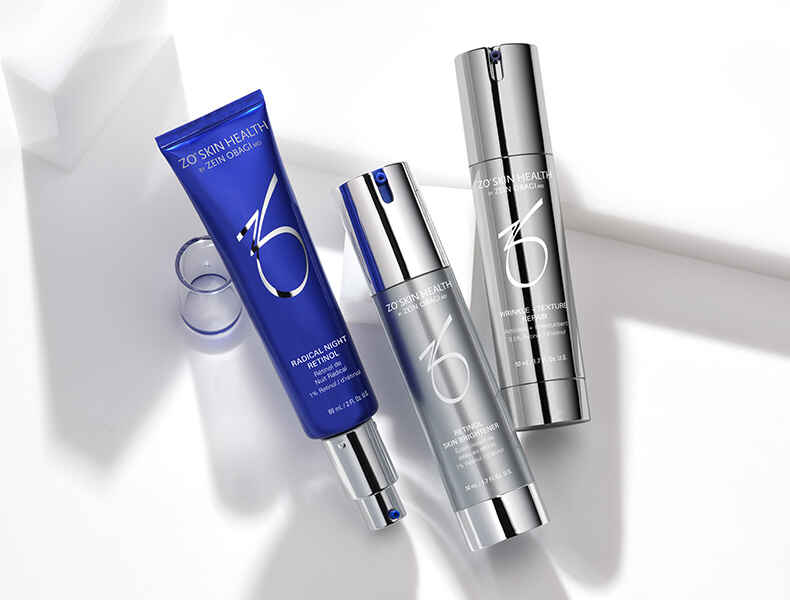
  5. Keep your skin active.  High concentrations of retinol will work to rejuvenate your skin, produce more collagen and accelerate cellular turnover.  Make sure that it’s a potent concentration, though—like in ZO Skin Health’s Radical Night Repair Plus.
  6. Exercise.  Here’s the one that’s not so easy.  Work up a sweat at least three times a week.   Take brisk 30-minute walks–you can stop and smell the roses later.  When you work up a sweat, you moisturize your skin from the inside out.  Avoid the temptation of saunas and steam rooms, though—they may seem refreshing, but actually dehydrate your skin.
  7. If your skin needs added moisture, it’s OK to apply a moisturizer.  Don’t overdo it, though.  Use moisturizers only as a short-term fix; they can cause your skin to become weak and lazy.

ZO Skin Health

TIP: Get Better Results with this 10-Second Tip

Skincare products that sit on the surface of your skin have little to no benefit.  Massage the creams/lotions into your skin until they have vanished.  Here are the added benefits:

1. Dr. Obagi recommends applying products vigorously in a circular motion.  You’re giving your skin added exercise to stimulate dormant cells.

2.  You’ll enhance the activity of the functional ingredients, because you’re increasing penetration and absorption.

It only takes a few seconds.  Give your skin a little extra exercise today!

ZO Skin Health

The Ten Most Vain Places to Live in the US

cosmetic-surgery-stem-cell

Where would you expect that the most vain people –the ones who believe in better living through surgery– live??

Forbes and Total Beauty found out what ten cities have the most plastic surgeons, tanning salons and spas/salons per capita.  Here’s the countdown:

#10  Louisville, Kentucky.  Go figure.  People there spend more on hair/skin/nail care.  Louisville also has more than its fair share of plastic surgeons.

#9  Minneapolis, Minnesota.  The winter cold there is brutal, and wreaks havoc on the hair and skin.  It’s understandable that they have so many spas and salons.  They need a little extra pampering.

#8  Charleston, West Virginia.  No kidding!  Charleston has more tanning salons per capita than NYC, Los Angeles, San Francisco, San Diego and Miami—combined!!

#7  San Diego, California.  Sure, Californians are consumed with their appearances.  But they also spend too much time outdoors during beautiful sunny weather.  So they have more wrinkles and skin laxity!  Advice from Dr. Obagi:  wear Oclipse SPF 30 Sunscreen!!

#6  Dallas, Texas.  Don’t mess with Texas!  People there spend more time and money in salons so that their hair and nails look good.

#5  Los Angeles, California. This one was a no-brainer.  The folks who live in Lalaland have more cosmetic plastic surgery procedures.  All of the nose jobs, lip plumping and breast enhancements add up.

#4  Salt Lake City, Utah.  There are more plastic surgeons here (per 100,000 people) than anywhere in the US.  Who knew??  One theory is that because Mormons have large families, women there opt for tummy tucks and liposuction—also dubbed “Mommy Makeovers”.

#3  San Francisco, California.  It’s a city best known for herbal and homeopathic supplements.  So they probably like to go au-naturel  on their skincare, haircare and nails as well.  And they pay more than most anywhere else, too!

#2  Miami, Florida.  People who live in Miami are rumored to eat too much, drink too much and smoke too much.  Now we know that they spend too much on manicures, pedicures, facials and hair color, too!

#1  New York, New York.  Everything there just costs more.  Facials, haircuts and massages help to relieve stress in the Big Apple.  Until they see their credit card bills…  Then they need to start all over again.

How about in your hometown?  Where do you think people are particularly vain?

ZO Skin Health

TIP: A 10-second trick to make your skin look younger


Putting on an eye cream?  Tap, tap, tap is for the birds, birds, birds!  Your skin is meant to be strong and tolerant, and babying your skin is like spoiling your kids—they grow up to be weak and lazy.

Instead of tapping your skin with your pinkie, Dr. Obagi recommeds that you pat your skin firmly.  You’ll be stimulating your skin cells—keeping them awake and vibrant.  Don’t overdue it, though—stretching and pulling and tugging will over-stress the elastin fibers.

ZO Skin Health

Preposterous Anti-Aging Skincare Claims–They’re Getting Kind of Old!

Smoke-n-Mirrors

When it comes to anti-aging skincare claims, who can you trust?  Good question, and the FDA wants you to know.  So they have published a list of companies that are making false and misleading claims.   In our opinion, it’s long overdue.  While the industry was not regulated, companies began making more and more unproven claims and publishing misleading photos.

And the companies that they’re naming–well, it’s a who’s-who list of skincare–Helena Rubinstein, Guerlain, L’Oreal, Lancome, Coty, Lancaster, Avon, Chanel, Estee Lauder, Elizabeth Arden, Shiseido–the list goes on and on!

Dr. Obagi is in favor of increased regulation–he has always been a great proponent of ensuring that skincare claims are fair and honest.

For more information, check out the following link:

http://www.accessdata.fda.gov/cms_ia/importalert_188.html

ZO Skin Health

Stay Cool!

If you live in an area where the temperature is soaring, your skin is under stress and duress.  Dry skin, eczema, acne-prone and sensitive skin are all especially problematic.  Here’s what Dr. Obagi recommends to get through the summer heat:

  • Sweating is your body’s way of regulating temperature.  Wear fabrics that allow your skin to breathe properly—like linen and cotton.  Spandex, lycra, etc. are comfortable, but they may trap sweat, congest pores and cause breakouts on your back or neck.
  • Hold off on facial waxing, glycolic peels, microdermabrasion, etc.  Avoid or reduce the use of products that contain high concentrations of glycolic acid, salicylic acid, retinoic acid or retinol.  They all work to expose new, younger, healthier skin cells, but in so doing, shed the dull, dry skin cells that have been blanketing your skin.
  • Drink plenty of water or a sports drink.  When your skin is not properly hydrated, it will appear more wrinkled, dry and damaged.
  • Apply a good sunscreen  (like ZO Skin Health’s Oclipse SPF30) about 30 minutes before going outside—it can take that long for it to be fully absorbed by your skin, and reapply it throughout  the day.  Sunscreens with physical blocks (like titanium dioxide and zinc oxide) are better than chemical sunscreens.
  • Avoid the use of products that are fragranced.
  • Wear a broad-brimmed hat.  Not only will it shelter you from the UV rays, it will provide some welcome shade (and protect your hair color!)
  • Opt for a treadmill instead of your favorite jogging path.  Now is the time to enjoy an air-conditioned fitness center.


ZO Skin Health

Guide for Identifying Beachgoers

CARTOON2

Headed to the beach this weekend?  Check out this cartoon by Dave Granlund first.  Only the novices (and the dummies) go the beach without UV protection.  Remember, wear SPF 30 (like Oclipse SPF 30 on your face) and a good body sunscreen (Dr. Obagi likes Neutrogena sunscreens); reapply it every 2-3 hours and after swimming or perspiring.  Better yet, wear  a broad-brimmed hat and long sleeves–like a Year-Round-Resident!  If you’ve been using retinoic acid or Radical Night Repair Plus, be extra careful about sun exposure.  Stay cool, and have fun!

Dr. Zein Obagi

What Does SPF Stand For? Your Sunscreen Probably Flunked!

SPF = Sun Protection Factor.  Or SPF = Your Sunscreen Probably Flunked. That’s right.  Even though physicians have been preaching for years the importance of wearing sunscreen, one bunch of treehuggers now claims otherwise.

Two years ago, the Environmental Working Group (EWG) challenged the safety and efficacy of sunscreens, claiming that the chemicals used in it can cause or accelerate cancer.  In fact, they claim that 80-some percent of sunscreens flunked–claiming that they are not safe and/or effective   That’s worrisome.

So let’s face the facts:

* EWG’s studies were done only on laboratory mice, and mice are much more susceptible to cancer than people.

* One of the ingredients that they claim is responsible is retinyl palmitate, which is a form of Vitamin A–which in fact is used in the treatment of cancer.

* the EWG generally prefers titanium dioxide and zinc oxide–two physical sunblocks.  On that particular point, dermatologists generally agree that physical sunblocks (which block the sun’s rays) are preferable to chemical ones (which absorb the skin’s rays).  So we agree.   But what should you do about it?

Remember the column that was first published in the Chicago Tribune, with advice for new grads?

“Wear sunscreen.
If I could offer you only one tip for the future, sunscreen would be it. The long-term benefits of sunscreen have been proved by scientists, whereas the rest of my advice has no basis more reliable than my own meandering experience.”

Sunscreen is still your best protection again skin cancer and skin aging.  Just reapply it frequently, use a minimum of SPF30 and  use it every day.

SHARE WITH YOUR FRIENDS: Facebook Twitter Youtube RSS
Contact Us | FAQs | Terms of Use | Privacy Policy | Site Map